Wednesday, February 12, 2014

Becoming Ill with Margery Kempe

Last week I returned to The Book of Margery Kempe for the first time since I read it as a senior undergraduate, nearly seven years ago. At the time I was a much disaffected and disenchanted young man, and, like Margery’s fellow travelers on her pilgrimage to the Holy Land, I was “most displesyd for sche wepyd so mech and spak alwey of the lofe and goodne of owyr Lord” (1407-8). Although I would be approaching the text as a more savvy reader with a different set of critical tools than I once possessed, I nevertheless worried I would still be turned off by the nearly impenetrable effulgence of affect, by a performance so hyperbolized that its excesses seemed only tedious and overwrought. I wondered if, this time around, the text would have the power to enchant.

Then illness struck. For three-and-a-half days I writhed and moaned on the couch as my temperature skyrocketed and hovered around 101 degrees, sweating and shaking in a feverish nightmare. Perspiration poured from my veins, chills riddled my flesh and mucus fought aggressively to carry the infection from my body. In fact, my body did not feel like my own, hijacked as it was by a virulent virus. Thus it was in this vulnerable condition that I vigorously engaged with Margery and, not surprisingly, my illness afforded me a wealth of sympathy for the afflicted mystic. Suddenly, like Margery, I was a contagious body.

I do not wish to imply that Margery’s mystical experiences should be read as sickness, or I would be as guilty as the folk of her hometown of Lynn who too easily conflate her bouts of illness with her affective responses to her encounters with the divine:

Sum seyde that sche had the fallyng evyl, for sche wyth the crying wrestyd hir body turning from the o syde into the other and wex al blew and al blo as it had ben colowr of leed. And than folke spitted at hir for horrowr of the sekenes, and sum scornyd hir and seyd that sche howlyd as it had ben a dogge and bannyd hir and cursyd hir and seyd that sche dede meche harm among the pepyl (2473-8).
Some said that she had the falling evil, for as she cried she wrested her body, turning from one side to the other, and waxed all blue and gray as if she were the color of lead. And then folk spit at her in horror of her sickness, and some scorned her and said that she howled as if she were a dog and banned her and cursed her and said that she did much harm among the people.

To read Margery’s weeping as illness is a dehumanizing gesture which seeks to equate Margery with objects much lower on what Mel Y. Chen would call an animacy "reference cline" by marking her as leaden and canine; Chen writes, “When humans are blended with objects along this cline, they are effectively ‘dehumanized,’ and simultaneously de-subjectified and objectified” (Animacies, 40).

I also do not mean to suggest that such a hierarchy is ontologically manifest, that humans are somehow privileged and more agentic than metals or dogs. Like Chen, I am interested in slippages along this hierarchy, I hope to uncover moments when the verticality of such a subject-making system is toppled and objects are perceived along an animacy continuum. Therefore, what I do mean to acknowledge is that my illness illuminated the real material excesses of the very condition of embodied being, material excesses of which Margery is fully engaged and aware, and which her townsfolk and other peers are too obstinate to acknowledge. Margery’s metallic flesh and bestial howling disturb the epistemological structure which shapes the desire to marginalize and exclude the very matter of our existence.

Although Margery Kempe’s union with the Trinity is spiritual, her experience of the divine is emphatically material and sensorial. The text relishes in the sensory details of her encounters, in the perfumed aromas of visitations, in the harmonious arrivals of inspiration, and in the corporeal extension of the body in the world, her torso thrusting itself into positions simulating the crucifixion. Her “boystows” voice (its disruptive agency thoroughly investigated by Jeffrey Cohen in Medieval Identity Machines) is perhaps so offensive to her interlocutors, as well as her unwilling audiences, in part because it carries all the material weight that my own contagious breath, redolent with viral particles, injects into my surroundings. Even the divine fire in her heart is more than mere metaphor, but a visceral burning she felt “as verily as a man schuld felyn the material fyer yyf he put hys hand or hys finger therin” (2063-4…or, might I add, if he should have a fever!).

Like Margery’s eruptions, then, illnesses are so abjected and abhorred precisely because they evidence a materiality beyond our control; our body seems not our own because it is not our own, but is instead an entangled network of organic tissues and fibers that we share with billions of bacteria, with the ephemera of other corporeal beings (see Caroline Walker Bynum for more in medieval fascination with and ingestion of sacred ephemera…or, if you live with a non-human animal, inspect your body for some fur or scales), and, occasionally, with viruses. Thus, the community that I forged with Margery over the past week was built from our shared engagement with matter and all its unpredictability. Our unwieldy and terribly strange bodies are always withdrawing from any understanding we might have of them. Margery’s keen attunement to her body offends precisely because it serves as an invitation to abandon ourselves to the superabundance of corporeal entanglements and to relish, even in illness, the excesses of the flesh.

Thursday, January 30, 2014

Quid Corpus Dicit?

Two days before the start of the spring semester, my partner and I visited a lesser-known – to the secular crowd at least – tourist site here in DC: the Mount St. Sepulcher Franciscan Monastery. Like a Catholic Epcot Center, DC’s Franciscan Monastery recreates with contemporary materials various holy sites of pilgrimage in Europe and the Middle East, including the Lourdes grotto, the Tomb of the Blessed Virgin Mary, the Chapel of the Ascension and the Tomb of Christ in Jerusalem, and, surely of most interest to me, the Catacombs of Rome. At once pastiche and genuine commitment to touching the past (more on that turn-of-phrase to follow), DC’s own Franciscan monastery is nothing short of awe-inspiring, if also likely to inspire an irrepressible giggle when a gaggle of nuns shuffle from France to Mount Olivet in mere seconds.

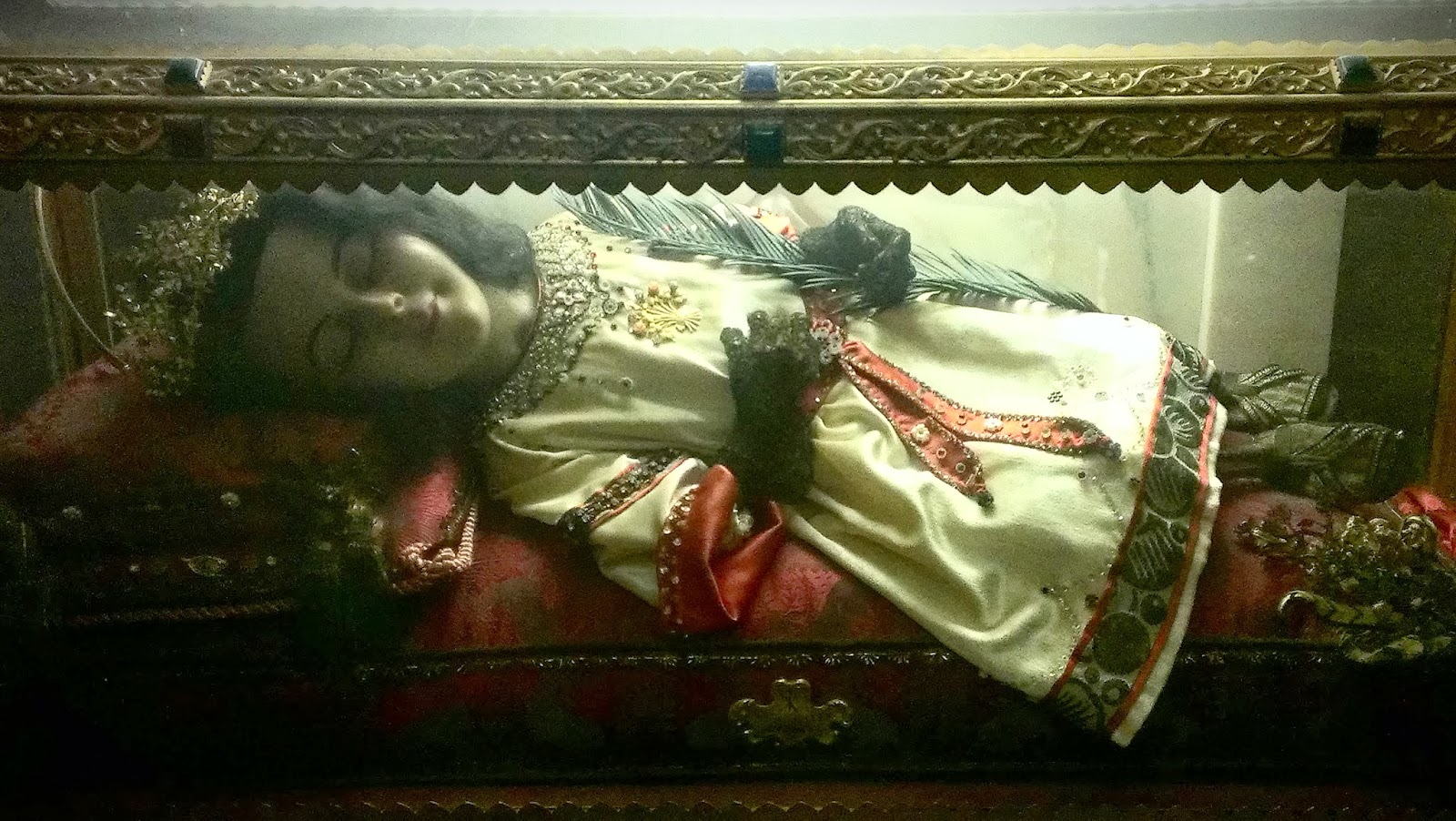
In the mock catacombs we encountered the enigmatic figure of St. Innocent, a child-saint sent to the monastery from Rome. Behind a glass box, low to the ground in a recessed wall, the figure of St. Innocent lay in death’s repose, immaculately concealed in pristine sartorial splendor, a death-mask of a child’s face frozen in a look that suggests an unimaginably peaceful slumber even as shriveled and blackened limbs sully the picture-perfect arrangement of the body. The juxtaposition of the sacred, unblemished relic with the gnarly evidence of the ravages of unholy time on human flesh is arresting; the imaginary is too polluted by the real. Also arresting, in a quite different sense, was our tour guide’s tale about this St. Innocent: an incorruptible (are you sure about that?), St. Innocent died as a child (no shit), and is now a patron saint of all (Christian) children. The end. Really, that was the most our tour guide was able to tell us about one of the only two actual corpses in their faux-catacombs, the other a relic with bone fragments from St. Benignus of Armagh, about whom our tour guide narrated ad nauseam.

As I spent the following week puzzling over, and then pretty much forgetting, the fragmented and incomplete – if not wholly fabricated – story of the mysterious St. Innocent, I was given the following as my first reading assignment for an independent study with my advisor: Saint Erkenwald. Oh, the uncanniness!! Oh, the dulcet resonance!! All the questions surrounding this ‘innocent’ child’s corpse appropriated by the Catholics and entombed in a Franciscan dungeo…excuse me, catacomb, rushed to the fore as I thought about what it meant for an early medieval bishop to pardon the soul of a “pagan” – read Welsh or British or, as Karl Steel might suggest, Jewish – judge. If the text is explicitly about fulfilling the desire to assimilate the past, it also worries about the violence that occurs when we touch the past, when humans make contact with and get caught in the maelstrom of the material flows of time.

Like the body of the cryptic St. Innocent, the pagan judge erupts into the narrative with an obscure story; after delving and digging “down deep into the earth" (45), miners hoping to re-establish the foundation of a cathedral built atop a pagan temple uncover a “wondrous fair tomb” (46).1 The earth gives up its treasure, an incorruptible human body, to these archeologists, these re-constructors of time and history, but it also conceals its occult story; the text hewn into the marble of the tomb is indecipherable. Unlike St. Innocent, however, the corpse itself is made to speak, is granted the opportunity to narrate its own history. The text is wonderfully mimetic in its description of corpse-speak, attending to the physical barriers that a well-preserved but nevertheless un-ensouled body might have in manifesting speech-acts: “Then he hemmed a little who lay there, and let his head roll, / And gave a great groan, and grieving he spoke” (281-2). The dead judge, buried for centuries, is as much an earthy elemental being as a human corpse; like Tolkein’s ents, beings of such enormous life spans that their temporal sensibilities are almost incomprehensible to the fast-paced and relatively short-lived hobbit and human audiences, the corpse is slow to speak, its joints stiff with immobility and its face groaning with age.

I do not mean to imply, however, that this body is ‘stuck in the past,’ that it is so sedimented in history that it is only an archaism, something to be excavated, studied, and assimilated. Clearly the anxiety of the text, its ambivalent temporalities (I dare you to determine precisely when it is set), the strange conditions of the pagan’s appropriation (accidental baptism?), the mixed responses of the crowd (mourning and celebrating), and the even stranger response of the body to Erkenwald’s touch and his embodied affective response (his tears, the very condition of the accidental baptism, catalyze the corpse’s rotting and turning to dust), ask us to make something more of this body, to let it continue to speak to us even after all that’s left are ashes. Although writing ostensibly about Beowulf and theory/criticism, Eileen Joy asks the following questions, quoted at length, that should be brought to bear on any conversation about the body and its relation to story and time:

Bodies (both dead and alive), history, and language, and all of the fiercely tangled relations between them – what do the dead want from us, what might we want from each other at any given moment, and how might we sufficiently record our past and present histories in order to lend some kind of meaning and ethical content to what some of us fear, deep down, is a kind of unscripted chaos? How, further, can the past inform our future in a way that is ethically and socially constructive? (LIII).2
Like Beowulf – and perhaps the Gawain poet –, I conclude that the dead want to narrate their own stories, and not just stories of their past, but tales without finitude or tidy resolution; with incorrupt or eerily mummified hands, corpses continue to reach into each successive present moment and touch whatever bodies surround them. It is the responsibility of the touched to allow themselves to feel with the dead, and not only about them.

After considering Jules Michelet’s embodied affective responses to the historical events about which he writes, Carolyn Dinshaw concludes, “The historian manages thus, by writing, to ‘touch’ bodies across time. Resurrection is the aim of his history, unreached but nonetheless signaled” (47).3 I would add that the scholar and the lay person alike make contact with the past any time a reaction to story is corporeal, any time anyone “shudders to think about” or “trembles before” memory, recall, the historical event or, perhaps even more significantly, physical evidence. When one is confronted with a corpse, with the tangible, material evidence of a prior life, one struggles to forge a community with what was, to engender a story, whether fact or fiction – likely a mixture of the two – in order to sympathize, to feel with the imagined life that once animated the dead.

Yet why do we feel the need to hunker down and dwell in an object’s history? Is not a corpse still a physical body animated by its own material flows, part of very present and very active networks? Why must we bury the corpse in frozen time and sediment its story in ‘the past’? Is a dead body no longer an agentic being in the world just because it no longer speaks? What if it can be made to speak, what then? If we dwell only on the body’s history than we are no better than an Erkenwald, appropriating its story to satisfy our presentist and perhaps nationalistic/religious/political needs. We should work instead to be like crowd of onlookers, looking with fresh eyes at the mystery of the body; just as “Much mourning and gladness were mingled together" (350) for the crowd, let us sympathize with the dead and celebrate the yet-untold stories of the corpse’s futurity.


1. All quotations from "Saint Erkenwald" taken from The Gawain Poet: Complete Works trans. Marie Borroff (New York: Norton, 2011): 167-183.
2. Joy, Eileen A., “Introduction: Liquid Beowulf” in The Postmodern Beowulf: A Critical Casebook, ed. Eileen A. Joy and Mary K. Ramsey (Morgantown: West Virginia UP, 2006): XXIX-LXVII.
3. Dinshaw, Carolyn. Getting Medieval: Sexualities and Communities, Pre- and Postmodern. (Durham: Duke UP, 1999).

Monday, April 8, 2013

Thinking the Inhuman

Driving home after the stimulating “Ecologies of the Inhuman” panel hosted by GW MEMSI, I was fortunate enough to have over 6.5 undisturbed hours to reflect, to worry, to chew over and to navigate the tumultuous waves of thought generated by the inspiring papers of my co-presenters and the invigorating Q&A session that followed (as well as the continuing conversations that manifested over dinner and drinks). As I looked out the window and embraced the contours and ecologies of Maryland, West Virginia, Pennsylvania and Ohio, I let my mind wander over and touch the myriad sights in the hope that my material surroundings would agitate and affect my reveries and give focus to the swarm of thoughts buzzing inside my head.

I tried to stop thinking of time and distance, realizing, thanks to Valerie Allen, that these measurements of matter tell me nothing of the things in themselves, but are only human approximations of quotidian qualities better left un-pondered. I wondered instead about the space of a mountain to the mountain itself. How might a mountain perceive its own morphology (metaphorically, of course)? Does a peak sense its base, and how might we investigate that sensation? And how little does a mountain really care (if it would even give a damn) that its slow slouching and vast expanding informs humanity’s very ability to think the slowness of deep time and the vastness of geological heaving?

As we drove through the highways that slash right through these mountain’s peaks, I couldn’t help but wonder how the lithic, the arboreal and the organic beings that constitute such peaks resist and/or desire to being so hewn. What qualities of stone and soil lend themselves to being sliced, how do the curves and crevasses of cut stone, the textures and hardness of igneous and metamorphic rock, of basalt, marble and granite inform our willingness to engage these lithic beings in our ecological thinking? And what of the road, itself a lithic body whose shape is designed by human architects? When does stone stop being stone and become the for-human paved highway? Go ask Anne Harris.

Passing through the cuts in Negro Mountain (yes, that etymology of that nomenclature is as racially problematic as it sounds), I mused over Alfred Siewers presentation as we drove through a veritable graveyard of dead trees, its woodsy corpses still whispering of a once-thriving community of arboreal splendor. These sylvan skeletons communicate the introduction of the invasive Gypsy Moth from Europe, a ravenous insect whose defoliating of various trees and shrubs was likely responsible for this road-side necropolis. Is the Gypsy Moth a Nidhogg, devouring the life-giving and matter-structuring tree Yggdrasill? Humans are surely co-implicated in the spread of the Gyspy Moth, our tourism, industry and even wanderlust (forces responsible for the hewn mountains above) continuing to aggrandize the problem, yet how much more complex is the ecology which weighs down the world-tree?

Of course, so much of this tourism serves for the sake of human desires for recreation. Thanks to Lowell Duckert, I am now more aware of the postures of violence implicit in our modes of relaxation. To recreate is to re-create, to tear down and ravage untouched spaces in order to create (and copy and paste) human ideas of recreational space. As we stopped at a state park for a bit of lunch, parking in a lot in front of picnic tables and swing-sets, I thought about the clear cutting and construction required to create a space for recreation. Yet, is not our continued fascination with our forests what stimulates the compassion of those who work dedicatedly to preserve and repopulate these dying woodlands? Of course, this is a very human model of preservation, and we should avoid the ethical high-ground of always assuming our intervention is necessary; we weep over dead trees but barely bat an eye as we eagerly exterminate millions of moths.

Situated somewhere off the highway in Maryland or West Virginia sat a primitive steel structure simulating Noah’s Ark. An advertisement for a church and an admonition against Christian notions of “sin,” this terrestrial barge got me thinking about Steve Mentz’s shipwrecks and I wondered, at first, how different this planet might look if Noah had been a shit carpenter and if his ark had simply sank. Noah was always already in the midst of such a shipwreck, just as Sodom was always already doomed to its conflagration, just as we are already struggling to stay afloat in the polluted sea of our undoing. Yet, the ark itself would not likely perceive the rending and hewing of its disassembling as the cataclysmic overture we would surely fear it to be (of course, had the myth concluded this way there would be no “we” to ponder this alternative scenario), but merely a morphing and shifting of relations, a carnival game of dancing densities and displacement, and a repositioning of carbon and calcium, watery dissolving and decay.

One sees a great deal of decay and decomposition driving through the Appalachians, and I wondered whether Eileen Joy would find herself at home amidst such a jungle of abandoned post-industrial fissures and breaks being reclaimed by that capital “N” Nature. What kind of violence is this tumbling, crashing, rusting, shifting, breaking, colliding, devouring and entangling of spaces and structures abandoned by humans? Is this the sort of violence that would stimulate Eileen? Do we share in that same affinity? Is it possible to be inspired and enthralled by apocalyptic forces, to revel in the ways we bring about our own destruction, and still maintain an alignment with humanity? Faced with an impending ecological crisis, is it even responsible to preserve a human ethos?

And what of this flux, this interminable flow of material forces that engenders (imaginary) Biblical shipwrecks and the vicissitudes of time? Passing through communities built upon the shores of meandering waterways, I sorted through the debris of thoughts left behind by James Smith’s wonderful discussion of “Fluid,” and worried over the fluid networking of geography and human ingenuity that shaped these odd entanglements of plunging yards, narrow homes, erratic roads and broken piers. The flows of a river might offer fish to feed a population, then flood farms and residences, forcing migration. Do these river dwellers have a natural flexibility, an innate “go with the flow” mindset that enables them to risk residing along uncertain shores, or have the floods themselves fashioned more malleable humans?

Stopping for gas and listening to the whirring and clicking of the fans trying to cool the engine, I realized how little I actually thought about the car itself which was working so dedicatedly to traverse the highways and with which I was so thoroughly embroiled and engaged (I was the guilty Dasein). I know nothing of cars, of the intricacies and mechanics that assemble and relate beneath the hood, but I do know that cars need oil and gasoline, they hunger for petro-carbons, and that our shameful thirst for environmentally destructive fuels does not translate into an automobile-ethos. The parts and pistons that propel the car have an affinity for petroleum-based fluids that lubricate and catalyze their connections. How do we think ecology when the objects of the world do not share in our anthropocentric ethics, the same ethics that are requisite should we wish to continue our co-habitation with all the beings (organic, inorganic, bodied, incorporeal, impossibly vast, unmeasurably tiny) on this planet? I would like to thank Ian Bogost for bringing my mind back to this dilemma.

This gas station at which we had stopped seems to have engendered a small impoverished town, a community whose sole purpose is to facilitate travel and tourism. So that we might drive through the cuts we’ve made in mountains in order to ask the challenging questions of ethics and ecology, these fueling depots and rest stops must be staffed and served by folks as often unnoticed as the homeless ambler that incited Carolyn Dinshaw to think about our “shared vulnerability.” Although their mobile home communities remain hidden miles past the rest stops and gas stations themselves, these homesteads exist and it is our responsibility, even in the event of our recreations, or tourisms or even our shipwrecks, to attend to those who are so deeply entangled with the forces of materiality and often the first to suffer from our carelessness and lack of compassion/understanding of the non-hierarchical connectivity of being.

I hope I have not done a disservice to the brilliant presentations of the folks mentioned above by misrepresenting some of their arguments, but I merely mean to share the questions that manifested in my mind as I sat in the passenger seat of a silver Saturn Aura for almost 7 hours letting wonder happen. I must also express my most sincere gratitude to Jeffrey Jerome Cohen for assembling this creative congregation of eco-critical inquiry and for being the ever-gracious host and a devilishly fun companion.

Tuesday, April 2, 2013

Dysphoric Materials, Anxious Materiality;
Guest Post by M.W. Bychowski

Crip Materiality: Part 2

“The body is not mute, but it is inarticulate; it does not use speech, yet begets it” The Wounded Storyteller, Arthur Frank

The genesis of this project, I feel, was a simultaneous approach between Alan and me. While I sent the message first, offering another collaboration after the success of September meditation on the Screams (Alan) and Whispers (myself) of Sugar, immediately I received a reply affirming that he had been pondering the same thing and wondering if I would be interested in doing something on disability and materiality. As with many stories told from the circulation of objects, there is no one origin story and I like that. This needs to be messy.

So if we are going to get messy, throw ourselves into the dirt, it’s at least nice to know that we will have company. Between a depressive self-management and a perhaps reckless, living out of my gender dysmorphia, I would rather throw myself under the bus in a life-ditch effort to come out somewhere else than get pushed. And as Alan’s generous post kicks at me, there seems to be at any given time, far more friends under the bus than riding in it (how many of those are hostages, I wonder?). Given all the dangers not only for queers and crips, but any young scholar right now, it seems all the more worthwhile to be candid, generous, and loving of each other. If we are going down (or wherever), let’s make a life and a living out of it, and let’s do it together.

The academic body (and I here, and will continue to include those outside of formal university structures as well in this) is itself a dirty, messy, collaborative, crip-tastic thing. There are reservoirs of experience, critical modes, and I would even say, a transformative physics or meta-physics to be better unleashed in crip(l)ing-materiality. Materiality can be pitched as an abstract counter-part to materials, as theory against activism, but in general and specifically in terms of cripness, I would rather posit materiality as the way that materials speak to each other, and to themselves. Crip Materiality is simultaneously a thing and a call towards ways of thinging.

In so many ways, Alan’s post could stand alone as a beautiful and artistic articulation of these points—without the need for such manifesto-like statements or anecdotes which I can offer. If only to provide a sounding board to echo and share in the resonance of his music, I will begin. In doing so, I will try to maintain a stance of unknowing about myself. While I orbit words like gender-dysphoria and anxious-depressive status, which I hold to as useful but dangerous institutional language on my body, it is critical to note that even in their own clinical context the materiality of bodies that “look-like-mine” change over time and include a wide variety of divergent threads which once or currently meet in the node called “transgender/transsexual:”

“Lothstein, in his study of ten ageing transsexuals found that psychological testing helped to determine the extent of the patients’ pathology [sic]…[he] concluded that [transsexuals as a class] were depressed, isolated, withdrawn, schizoid individuals with profound dependency conflicts. Furthermore, they were immature, narcissistic, egocentric and potentially explosive, while their attempts to obtain [professional assistance] were demanding, manipulative, controlling, coercive, and paranoid” (Walter and Ross’s Transsexualism and Sex Reassignment).

Thus, I hope that the murmurs of my materials will mess-up in the best possible ways and escape their own internal materiality. If there is music in it, may it be an invitation to join in on the dirt.

Disordered Materials

“Here the surface of the artifact is not just of the particular material… But of the materiality itself as it confronts the human imagination” Materials against Materiality, Tim Ingold

“Don’t you just think we think too much about gender?” our family doctor asked me, his pen mindlessly clicking his clipboard. I sat across the room from him on the edge of a metal table, covered over in butcher paper; as a piece of meat, I thought.

When my mother scheduled this check-up, just to get a few booster shots while I was still under her healthcare insurance, she warned me that our doctor told her that he had some opinions about gender disorder (now classified as a dysphoria). As our meeting stretched on, longer than was needed to cover the details I was there to address, I realized I was going to be subject to a lecture.

“Don’t you think we think too much about gender?” he asked again, after mulling on his philosophy of medical-minimalism (the word “reductive” appeared in my mind). This time, it sounded more like a statement than a question. Responding to the content and not the premise of what he said, I told him about my image of gender as a kind of material flow, a node where people and things form logics of their own, but where currents can cut in and pull you elsewhere. He asked about my plans for surgery.

“I don’t see the point in top surgery,” he responded. “Breasts are just bags of fat, after all.” Once again, I felt the twinge of minimalism and reductivism meeting. That’s what they are made of, I thought, not what they are. Like his other questions/statements about gender I wondered first, if he was not a straight white male if he would still feel like gender talk was an inconvenience, and second, if we were not coming to my body and my materiality from very different world-views.

Little did I need to reveal the materials of my body, he saw many of them: my padded bra folded on top of my dress, the meat and fat in my chest that yearned from transformation; as well as things he did not: the blood that surged with conflicting hormones and the nervous-neurological systems that give me the internal-mapping of a woman, trapped like a phantom in bits of flesh coded with masculinity. Other materials, like the silicone I left at home or the coming edge of a surgeon’s knife, were nonetheless a critical part of my body, and not invisible but at a distance.

Yet as his comments made clear, it was not my materials that he was wholly ignorant about, the things he called “just” things, or raw things, but he knew even less about my materiality. For him, as far as he shared, the materiality of my body was a code, a map of organs and tissues that he could name and order on a diagram in med-school. The word “just” told me how little he thought of breasts or gender as more than abstract colored shapes with names attached; data he needed to do his job and pass exams.

The Materials and Materiality of Dysphoria are not so easy to distinguish for me. When I close my eyes, and the body I see disappears (the empirical fact medical science privileges), I feel my body in space; I have breasts, wider hips, and a narrower pelvis. Moving my hands towards my chest, I can feel five or six inches from my ribs, a presence of this body: warmth and pressure.

My nervous system sees and reacts to a womanhood that cannot be so easily seen from the outside, yet. Laying in bed with my lovers, I see myself transformed in their eyes as their fingers outline a body coming-to-be, but already before them. Getting dress among my sisters, our bra-straps mark an alliance, as we start a day in a male world.

“Don’t you think we think too much about gender?” he repeated as I got ready to leave. My materials answered him as I got dressed; the object(ion)s of trans-carpentry answering medical materialism.

Anxious Materiality

“For fresisshly brought it to my remembraunce That stableness in this world is ther noon. There is nothing but change and variaunce” My Complainte, Thomas Hocclave

Blood smeared across my hand in flecks of red and brown. Feeling it between my fingers I looked down at the door-handle to my freshman dorm. Memory. Prediction. Panic. Time speeds ups with a multiplicity and rapidity that I cannot process everything that arrives at once:

Two days prior my room-mate had attempted suicide while I was down stairs trying to be social. On most nights I would have been there reading when he got home. Instead, I had taken an invitation from the guys on the first floor, so when my room-mate came home, full of various toxins (I never asked which) fresh from breaking up with his boyfriend, he was alone.

At the last, he panicked and opened the door, passing out in the hallway. I saw the ambulance lights from down-stairs and when I tried to get back to the room I was stopped. “Who are you?” asked a cop. “The room-mate.” They took my name and told me I had to find somewhere else to sleep that night. I got some information from those that found him, but it was over a week before I found out what happened in more detail, how his body responded, if he had lived.

Anxiety is related etymologically to death. Sometimes I can see the connection directly in experience. “Panic attacks feel like you are dying, but you’re not” I’ve often told in the midst of an attack; information I find more comforting when I am not experiencing it. Data helps anxiety, not panic. Panic feels so much worse than the thought of death, because it contains so many multiplicities that I cannot distinguish one story from another, one scenario from another, one life from another, one death from another. The materiality of panic is as a part without a whole.

Unmoored from the position of carpenter, I become a passive production within my own ontological sphere. Describing my materiality to myself does feel nice in a moment of heightened excitement or anxiety (my physiology cannot distinguish between high levels of “positive” or “negative” stress). Anxious senses and analytic thoughts process hotter than a normate body. Information floods my brain from the events around me, the proximity and demeanor of people, their clothes and level of manicure, routes in and out of a position.

This is followed by a rapid running of odds: What if X happens? What if he says Y? If I move here, what scenarios can I predict? That’s part of why I don’t like crowds: too many contingent factors, makes calculation difficult, the process of analysis which keeps me in the realm of anxiety and away from panic. In many ways it feels like I’m playing a game with death, full of enjoyment and fear. Too much data however and my processor overheats and systems reset.

For several days after my room-mate permanently moved out, I had a long quiet. No one asked me a question about it since the cop asked my name. During that time I read in the library. Come the weekend, my mum came up to see me with a care-package: sweets, a DVD and a sketchbook.

Drawing is a calming mechanism. While running odds and scenarios manages my anxiety, drawing does what sitting with a limited view of a crowd does, what writing does: focuses everything to a point. Rather than running multi-functions, I take on one. Over time my heart-rate slows. The danger here is the opposite extreme: depression, a mental and emotional singularity which holds on to me like a black-hole. Rather than seeing 3 steps ahead in multiple directions, I look further and further down this one line, 3 steps, 9 steps, 81 steps, more and more until I see a view which floods my vision.

After my mom leaves, distracting me with rhythmic conversation, I turn on the DVD: Happy Feet. It’s the first time I really give penguins (dancing or otherwise) any thought; or rather discover how they thwart my thought. No calculations, only interruptions. It is data without content, without futurity, without alternative. Anti-data. I watched this DVD many times over the next month. As the people came and left, the penguins & my books stayed up with me

Dysphoric Materials

“I don’t feel strange, more like haunted” the Forgotten, Green Day

$4,000 (or so, depending on the location, quality, and painlessness of the service) gets transferred out of my bank account; perhaps less if my insurance company changes their position on trans-healthcare. In that unlikely case, the money comes with the exchange of time: 1-2 years of clinical surveillance until a doctor tells the state &insurance company that I qualify for help.

Taking off my clothes in the doctor’s office, I put on a paper dress. I’m starving, my stomach emptied of food or water for at least twelve hours. The room is empty of my friends and family as I change. Then a nurse comes in and suggests I lay down on a rolling bed.

An anesthesiologist comes in and gives me two options: a gas mask or a needle. In the case of a mask: a machine that looks like a plastic propane tank attached to a bunch of tubes, dials, and making a clicking noise is brought over. As the clear plastic muzzle is strapped around my head, I feel the strange alien lung breath into me: pumping a mixture of air through the tank, a liquid reservoir of volatile desflurine, isoflurine, or sevoflourine is mixed with nitrous oxide. At first it feels like I’m breathing in steam, until the tingling in my chest becomes a sparkle in my spine and beyond my eyes, then my eyes become heavy.

Or in the case of a needle, a bladder hanging from a metal stand out of sight is brought behind me so I can’t see it. The nurse talks to me (a distraction) while a sterilized needle punctures the skin around my wrist, joining with a clip to hold it in place. Propofol (C12H18; called “milk of amnesia,” a molecule that looks like a bull’s head), Edomidate (C14H16N2O2 ; a molecule that looks like a log), Methohexital (C14H18N2O2; a molecule that looks like the big dipper) or one of a few other strange, haunting, forgotten fluids dance through the vein & into the blood stream.

Chemicals ripped from their homes in plants, rocks & pools in Israel, India, China to stay with me for a few hours to hold my hand through my material transition. Running through my circular system, the chemicals bond to proteins, particularly in my brain, and a quiet loss of feeling and care suggests that I close my eyes.

While I’m asleep, my bed is lowered into a flat position; any one of my loved ones that had ventured back into the room to stay with me through this moment of physical panic meeting chemical peace look on as I am wheeled into the room down the hall where men and women in blue masks and gowns are waiting for me. The blue garments are there to shield their clothes and skin for the blood that will escape from my chest. It is potentially dangerous for my (unfiltered) blood to mix with theirs: I contain enough dysphoric materials to unsettle their materiality.

The hands of the doctors, nurses and aids work mechanically, from years of rote training (part of what I am now paying for), and arrange my body amidst tables of shiny instruments. The anesthetic holds my consciousness down as the surgeon’s stainless chromium steel blade (formed by Swiss machines) cuts into my skin (under the arm, the breast, or nipple). The incision is slight but enough to allow the sanitized and covered finger of the surgeon to push into my body, pull at my skin like elastic, so the opening can be positioned to allow them to begin the insertion process.

A pocket of space is created either under the muscle in the chest (more stretching) or else above it and below the skin. Into that is placed a shell of silicone rubber (where the silicon and oxygen become long chains of Silicon-Oxygen-Silicon that will clump together or unravel, allowing for elasticity). Within the shell are either a sterilized saline solution (salt and water) or silicone gel (more fluid and mobile chains of silicon- oxygen, forming around a carbon-hydrogen chain).

Joining with my muscle, tissue, and blood, the silicon (one of the most common materials on earthy, after carbon, mostly found in sand, quartz and a rosy kind of geode; my breasts will literally be two beautiful squishy sand-bags and water balloons) all come together to form the basis of my transformed breast. A needle, thread, and bandages seals me up. I’m cleaned as I’m wheeled back into a room where others are waiting for the sleep to wear off. As I wake up, this dream ends and I’m in my bed at home, still a year (or so) away from this particular operation.

Depressed Materiality

“Thu schuldist not plesyn me so wel as thu dost whan thu art in silens And sufferyst me to speke in thy sowle.” The Book of Margery Kempe

“I don’t like answers” a priest friend told me once, “answers get people killed.” Answers bore me and when I get bored, I tend to get depressed. Logic can produce perfect circles, Chesterton reminds me, but incredibly small ones. Materiality which follows a single stance through to infinity (as my anxiety can sometimes push it towards) has the ability to shrink the circle until it becomes a loop of emotional bondage, a suffocating point. Elsewhere I’ve described it as a tense grey that has forgotten color and dimension in its perfection of shades, light, and dark.

When the weight of the whole universe is brought down on a single point, things seem to collapse into themselves. Same folds into same and the answer becomes a hollow deterministic end. Answers kill.

And yet on the borderlands of this event horizon is a brilliant, vibrant darkness. Absence dwells there and sings to us of things departed. Beings sit there in their solitude, watching the little becomings play and relate like stars in the distance. Old gods and humble daemons lean back on the relics of the universe, bringing materials and materiality so close that the distance between them hardly needs to exceed a whisper.

Walking alone at night with an iPod drained and useless, I feel a wave of melancholy wash over my body and for a moment I am quiet and still. Something has changed, something has died, and because there is no void, the beginnings of something else are creeping in to take its place. Without death, without depression, transformation would be impossible and without transition to mark a passing, without commas and periods to punctuate its murmuring, materials could not speak of the experience nor have the openness of mind to listen.

MW Bychowski is pursuing a doctorate in philosophy in Medieval and Early Modern Literature at the George Washington University, concentrating on non-modern theories of transformation; particularly those concerned with ecology, disability and gender. In addition to her research, she directs MATCH a working group for critical theory; maintains Transliterature, a blog on philosophy and cultural studies; as well as consults for campaigns in Maryland and DC on issues concerning healthcare, women’s rights and trans/queer politics.

Friday, March 1, 2013

Desiring-Yonec

Initially nervous about returning to my long neglected blog with this somewhat experimental post, I reminded myself that with a blog there are no real threats, only opportunities. I lose nothing by experimenting with ideas I may never return to, but I just might gain some constructive criticism, so why not risk it? That said, I would also like to preface by acknowledging the influence of Deleuze and Guattari’s Capitalism & Schizophrenia on the content and style of this post. It only felt natural that after attempting to think in their erratic, elliptical and recursive syntax, I should want to write in such a manner as well; that’s just how I grok!

The titular character of Marie de France’s 12th century lai, Yonec, is hardly the hero or primary protagonist of the tale. Engendered midway through the narrative, Yonec has just one real function in the story: to carry out the revenge plot conceived coeval with his own conception. If the lai has a hero at all, it is the unnamed shape-shifting figure who rescues the story’s damsel in distress, it is the magical being whose significations transverse the organic and the inorganic, a becoming-hawk, becoming-desire, becoming-seed, becoming-blood, becoming-ring, becoming-sword. A preponderance of evidence signals his association with Breton lai fairy cultures (animal-being, city through a hill, towers of precious metal, magical weapons and accessories); however, as the text does not explicitly define the unnamed character as “fairy,” the hero becomes that which escapes definition, something that exceeds boundaries, a series of intensities, a rhizomatic figure, a body without organs.

From its inception, Yonec records the desiring-production of its own generic tradition. The lord of Caerwent locks his wife in a tower, à la persecuted maiden motif, as an act of jealousy, of worry she will go astray. Is it not his own desire that will go astray if she is two-become one, if the marriage union is completed in love and trust? The tower defers and displaces desire in order to maintain that which he cannot have, just as the narrative must continuously defer our desire for resolution in order to justify the plot, the middle, the plateau. The narrative records and produces desire by disconnecting the wife-machine from the social order. The wife-machine withers, disconnected from other machines, from other flights and flows. The wife-machine desires to reconnect to a body without organs, a hero, a hawk, a reader.

The unnamed rhizomatic hawk-man-machine (given the kaleidoscopic performance of this character within the text, I deploy various appellations throughout essay to designate the ineffable protagonist) does not initially rescue the confined damsel (that would consummate and thus eliminate the desire that nourishes the plot), but instead repeatedly visits the wife-machine to plug into her (the text is fairly explicit about the frequency with which sexual intercourse is engaged). “Desire constantly couples continuous flows and partial objects that are by nature fragmentary and fragmented. Desire causes the current to flow, itself flows in turn, and breaks the flows” (Anti-Oedipus, 5). Excesses produced by desiring-machines flow into other desiring-machines, and the spilling over of intensities from the hero-machine force a coupling with the partial object of the disconnected wife-machine, engendering further desire and extending the narrative of production.

The result of this excessive coupling and flowing is the restoration of the wife-machine’s beauty which had initially faded as a result of her being disconnected from all other social flows in her isolation. The spilling forth of the lust-hawk-machine into the wife-machine, like the oiling of a rusty motor, produces discernible changes and thus spoils the flow by introducing new intensities into the narrative; their passions are discovered and the hawk-man who has been parasiting the lord of Caerwent’s wife (in an act of metaphoric substitution by which the lord’s desire is being consummated by the hero-machine and thus rendering the lord impotent) is mortally wounded by a spike left in the window by the lord.

This violence, this interruption of the hero’s flows, introduces new desire into the narrative: desiring-revenge. The retributive desire is only possible because the means of its execution has already been produced: Yonec. After receiving his mortal wound from the spike, the hero-machine tells the wife-machine that she is carrying his child and that “[s]he was to call him Yonec, and he would avenge both of them and kill his enemy” (Lais of Marie de France, 90). Yonec is being already spilled forth from the hawkman, he is a surplus of information, a recording/production. Sperm is a flow, “produced by partial objects and constantly cut off by other partial objects, which in turn produce other flows, interrupted by other partial objects” (Anti-Oedipus, 6). The lust-flow from the hero-machine produces the retribution-machine in the form of Yonec, who in turn produces desiring-revenge which will be interrupted by the consummation of that desire and the resolution of the narrative.

At this point the narrative further develops the multiplicities and bodily excesses of the hero-machine. The mortally wounded knight, the desiring-sex-machine (a seemingly cancerous body without organs, sedimented in a strata of sex and rivalry; see A Thousand Plateaus, “How Do You Make Yourself A Body Without Organs?” 163) is made becoming-map, is a cartographic machine which leaves a trail of blood, a sanguine flow which produces a new desires in the wife-machine: the desire for death, in the figure of the bleeding hero-machine, and the desire for freedom from the boundedness of being-human. “The map is open and connectable in all of its dimensions; it is detachable, reversible, susceptible to constant modification” (A Thousand Plateaus, “Introduction: Rhizome,” 12). A wounded hawk is a bleeding man is a trail to freedom is a desiring-escape. Blood is a flow, a spilling forth of intensities; it is deferral of desire, a reversal of fortune and a new channel through the narrative. It is a path to becoming-fae, a change in valence, an abandoning human discourse (again, although it is not explicitly stated in the narrative, the text does associate the knight with many of the motifs of the medieval fairy). Although a path signals a trajectory, a definable wholeness, it is merely a single tracing on the hero-map-machine. “Is it not the essence of the map to be traceable?” (A Thousand Plateaus, 13). If his hero-machine-being is the map, is cartography itself, his blood is one path, one trace, one iteration (from Latin iter, itineris: journey, road, route); it is a guide to otherness, to an Other’s symbolic realm, the valence where fairy logic transposes and disrupts anthropocentric discourse and cultivates the desire for annihilation.

The rhizomatic nature of the hero-machine is developed further when the wife-machine locates his bed chamber and receives two magical objects from him: a ring of forgetfulness and a sword of vengeance. “The knight…gave her a ring, and told her that as long as she kept it her husband would remember nothing that had happened and would not keep her in custody. He gave and commended to her his sword, then enjoined her to prevent any man from ever taking possession of it, but to keep it for the use of her son” (Lais, 91). The objects are valences, flows, traces on the cartographic machine. The knight-as-desire-deferred is becoming-ring and becoming-sword, and the ring and sword are becoming-knight, becoming-desire-deferred. The objects connect, conspire, engage, assemble, all to produce desire, to compel the narrative forward by enabling the inevitable reprisal that will eradicate desire and conclude the plot. (Although this reading of objects seems anthropocentric, an orientation I vehemently shun, I argue that although the ring and sword are purposive and ready-to-hand for human consumption, it is only one valence of their machinic-being by which they lend their agencies to the wife-machine, hero-machine and reader-machines of the tale, evidencing a lack in the human characters, a need for object-relations.)

The knight is a rhizome; each division of himself is still the same machinic identity, wholly indivisible yet multiplicative beyond a parts-to-whole relationship. He is an ever reaching and endlessly connected assemblage of hawk, man, fairy, ring, sword, blood and semen. Thus, Yorec, the excess and flow of the hero-machine, who is himself an excess and flow of animal (human and non-human) and inorganic objects, is simultaneously a new machine, a desiring-production retribution-machine, and a trace, a valence, an iteration of the coupling of the rhizomatic knight and the wife-become-mother-machine. The flows of vengeance, the desires of the readers and the trajectory of the narrative have been indelibly recorded in Yonec, the retribution-machine. When the mother-machine inevitably discloses to Yonec the truth of his parentage and the cruelty of the lord of Caerwent, Yonec slays the lord with his father’s sword, manifesting the desires of the hero-machine, the wife-machine, and the narrative itself. Thus, with vengeance enacted and order restored, the flows of desire which sustained the plateau of the text are extinguished and the lai reaches an end; there is nothing more to be desired.

Tuesday, May 15, 2012

Kalamazoo

This past weekend I attended my first International Congress on Medieval Studies at Kalamazoo, MI, as part of the GW MEMSI panel “Ecologies.” While each and every paper presented by my fellow panelists was illuminating, if not absolutely brilliant, I was most captivated by Carolyn Dinshaw’s discussion of the ubiquitous image of the green man, that foliage enshrouded face, sometimes wearing, sometimes spewing vegetable matter, which decorates so many abbeys and cathedrals throughout Europe. The green man image has always interested me, primarily because it challenges and worries at the imagined boundary between human and non-human (in this case, vegetable) objects by illustrating a body shared equally, perhaps symbiotically, by human and plant. What I found most remarkable about her paper, however, was the anecdote about the interruption of her studying the green man by a vagabond, homeless-looking woman, a discretely human object that caught Carolyn’s attention while she was photographing the architectural ornaments. Here we are on a panel at the invitation to talk about that which is “utterly non-human,” and yet Carolyn pauses to dilate upon the meanderings of a very human thing, a pause which seems incongruous if not directly counter to the efforts of the panel. I was momentarily stunned.

Yet the title of the panel was “Ecologies,” and what is the promise of ecology if not an attempt to connect to, touch, relate, assemble with objects that are often left out of anthropocentric networks? And what is a homeless woman if not an object that is marginalized, abandoned, neglected, untouched, un-assembled, ejected from the most potent and puissant human networks? Thinking about this woman calls to mind Levi Bryant’s description of dim objects, “objects that only lightly manifest themselves in an assemblage of objects,” objects that only appear briefly and have no real political or social voices (1). Perhaps it is the duty of the ecologically minded to notice dim objects and shine a little light their way. Thus, amidst all of our work to invite non-human objects into our assemblages and to call attention to all the non-human objects that are always already at work within our networks, Carolyn reminds us that there are a great many human objects whose agency is often overlooked and who need to be enveloped and embraced by larger social bodies.

Perhaps I was so taken by this brief anecdote, this passing mention of the homeless woman, because I felt myself very much an example of a dim object at Kalamazoo. I arrived alone, an “Independent Scholar” with no relation to an institution; I spent hours wandering the WMU campus with no mæg, no mamaþþumgyfa, and no meoduhealle to call my own(2). Things relate, touch, connect, but as I walked through the various Goldworth Valley buildings searching for the registration table, as I squeezed through crowds and skirted by laughing, smiling, conversing storms of conference attendees, I felt utterly and absolutely withdrawn, like I had completely receded from view, and I wanted to scream “Would someone fucking touch me already?!” A hand on the shoulder, a brush of an elbow, a look in the eye; as focused on and interested in non-human relations as I am, I was surprised at how ravenous I was for a simple human connection.

Fortunately I had made the very wise decision to attend Thursday evening’s postmedieval roundtable discussion; Jeffrey J. Cohen, the person responsible for my being a lonely, dim object in Kalamazoo in the first place (the effusions of gratitude will come later in this post), was in the audience, and upon noticing my lone figure sitting in the back of the theater, he invited me to sit with his cadre of GWU graduate students and professional colleagues. I diffidently approached this motley coterie, doubting they would warmly receive a man of no mead-hall, and, to my deepest surprise, I was instantly enveloped by so much warmth and conviviality, I was so unwaveringly invited to join this little cabal, that I recognized my isolation had been primarily self-imposed. Inspired further by the theatrical performance of The Material Collective, which was delivered by various bodies scattered throughout the audience and complimented by free wine, and their message of the need for unity and strong relationships amongst those wanting to brave unconventional, theoretical, interdepartmental academic work, I determined to spend that night and the following day building as many relationships and connecting to as many medievalists as I could.

At a conference like Kzoo, things once assembled quickly disassemble, then re-assemble, never as the same assemblages they once were; micro-assemblages and swiftly shifting networks are the status quo, so keep up. I felt like alabaster, which is moist and malleable when first harvested, but swiftly loses its water molecules, hardening mere minutes after it is excavated. Yet hardened alabaster is still pliant, still soft, still supple; it is easily scratched and easily carved. Alabaster wants to be touched, it wants to connect with hands and tools and, never losing its chemical desire to recombine with water, it welcomes transition and transformation (3). Thus, like a raw chunk of alabaster, I left myself open to being touched and shaped and changed, and I fortunately fell into a crowd of eager hands: those involved with BABEL, postmedieval, and/or GW-MEMSI. These folk are all hands (curious hands, but not lecherous ones), they reached out to a chunk of rock eager to connect and, while respecting its qualities and chemistry, polished its rough edges and carved indelible marks into its surface.

This cadre of medievalists reminds me of Bryan’s rogue objects: “These are objects that aren’t locked in any particular assemblage or constellation of objects, but which rather wander in and out of assemblages modifying these assemblages in a variety of ways”(4). I don’t mean to speak for the individual actors that constitute the BABEL/postmedieval family (especially if they would disagree with me here), but rogue object seems a perfect appellation for this group. Instead of shaking its fists at the institution, it passes through, wanders, engages, disrupts, jars, slices, shifts, mutates and upsets the rigid status quo of the capital “U” University by modifying it from the inside via brief, roguish acts of unconventional scholarship. And its members are very much a family, nurturing, supporting, embracing each other and welcomingly receiving new friends into the fold.

I would love to wax on about my too brief experience at Kzoo 2012, but I fear this blog post would just turn into some mawkish gushing about the remarkable people who made my first medieval conference such a valuable, validating and entirely unforgettable experience (assuming it already hasn’t). I do, however, want to express my utmost thanks to the two individuals who made my experience a true success: Jeffrey J. Cohen and Eileen Joy. Jeffrey’s unwavering confidence in me and his enthusiastic support for my work got me to Kzoo in the first place, and Eileen, well, Eileen is just a fucking rock star. Thank you both for teaching me that academia can be collaborative and not just competitive. Let the cut-throats cut each other, we have sweet music to make (yes, that is a somewhat veiled allusion to my “Ecologies” roundtable paper).

(1)Coffield, Kris. "Interview: Levi Bryant". Retrieved 14 May 2012.
(2)No kinsman, no treasure-giver, and no mead-hall, O.E. from The Wanderer…obviously.
(3)I am indebted to Anne Harris whose passion for alabaster is infectious.
(4)Coffield, Kris. "Interview: Levi Bryant". Retrieved 14 May 2012.

Thursday, May 3, 2012

Human

Next weekend I'll be losing my Kalamazoo virginity at the 47th International Congress on Medieval Studies! So, I figure a little foreplay is desirable, no? Thus, I am posting the text of the 6-minute talk I will be giving as part of the George Washington University Medieval and Early Modern Studies Institute (MEMSI) panel, "Ecologies." To briefly describe the panel, I will borrow directly from the e-mail invitation I received from Jeffrey Cohen: "By exploring how environment and the nonhuman (with an emphasis, perhaps, on that which seems utterly nonhuman) matter in the Middle Ages and Early Modern period, we hope to map out new ways of thinking about bodies, elements, agency, and place." I decided that, instead of focusing exclusively on the "nonhuman," I would instead try to make the human itself seem nonhuman. Hopefully, I've succeeded. Enjoy, and PLEASE COMMENT so I can improve this baby before Kzoo!

One of the most unsettling, disanthropocentric acts we can attempt is to envision a more capacious definition of “human” by looking at ourselves from the perspective of non-human units. When we can acknowledge the shapes and features that we share with other objects, when we see ourselves through the literal or imaginary eyes of other things, we look utterly strange and alien. As Timothy Morton declares, “All organisms are monsters insofar as they are chimeras, made from pieces of other creatures. The strange stranger is strange to herself, or himself, or itself”(1). If we can see ourselves as monsters, chimeras, aliens, if we know our bodies are not human bodies, but composites of pieces that belong just as equally to other beings, we can de-locate the human from the singular position as subject of an impossible correlationist reality, the illusion of a Cartesian duality will fade and we can begin to see how utterly enmeshed we are with all other things in the universe.

Following the lead of Ian Bogost’s project to “see” the material world through the eyes of non-human units, as detailed in his recent work Alien Phenomenlogy, I propose that we investigate what other objects perceive when they interact with and engage humans. Although it is unarguably impossible to ever know the subjective experience of another being, to sense what an undulating wave senses or to perceive what a gamma ray perceives, these acts of sensation and perception are themselves unique objects that we can worry over and that tell us more about the unique experiences of objects. As Bogost states, “The experiences of things can be characterized only by tracing the exhaust of their effects on the surrounding world and speculating about the coupling between that black noise and the experience internal to an object” (2). By investigating the black noise produced by the relationship between non-human and human objects, we will begin to understand how other units interpret humans and, consequently, see ourselves as both more and less than the sum of our current self-awareness.

Literal noise graces the brutal narrative of Chaucer’s Prioress’s Tale, in which a young Christian child is murdered by Jews for his singing of the Marian antiphon Alma redemptoris, and yet whose body continues to sing post-mortem. In Music, Body and Desire in Medieval Culture, Bruce Holsinger explores the material agency of music in the Prioress’s Tale as it is embodied and commits violence against human flesh through the medieval pedagogical tradition. He argues that, “the Prioress’s Tale exposes the horrific acts that music is capable of provoking, sustaining, and, perhaps most insidiously, aestheticizing for its medieval listeners and modern readers”(3). While his work is admirable for its validating the independent role of music as a Latourian actor in often brutal human narratives, his study never relinquishes the position of human-as-subject, always imbricating the agency of music within explicitly human networks (e.g. the pain of striking and beating a body to produce sound, or corporal punishment as a form of musical pedagogy). What happens if, instead of assuming music is inextricably linked with violence against the human body, we look instead from the perspective of music itself, if we look at the particular iteration of music, the Alma redemptoris hymn, as a subject that works to perpetuate its own existence regardless of what type of material within which it finds itself embodied?

Investigating the behavior of the Alma redemptoris is much like following the path of a virus (4); a song needs, a priori, a host from which to germinate, and the song enters the narrative as it erupts from the throats of school children, organic bodies who perform as instruments for the manifestation of the song. But a song will emerge stillborn from its sire if there is no other body to hear it; thus, like the song of a siren, the Alma redemptoris exerts its self-sustaining agency as it captivates the “litel clergeon” and draws him “ner and ner” (520)(5). The instant it graces his ears, the pathogen-like song infects the protagonist and ratchets itself so deep within his memory that he cannot forget the tune, even though “Noght wiste he what this Latyn was to seye” (523). The Prioress’ child becomes a captive of music’s indelible need to perpetuate its own being.

Once infected, the “litel clergeon” shares his physical body with the Alma redemptoris; “twies a day it passed thurgh his throte” (548). The Prioress’s boy is simultaneously an instrument for the production of music and a host from which the Alma redemptoris continues to replicate. Even after the human body is murdered and cast in a privy, the musical instrument that shares the very same parts, the very same space, continues to produce and spread the Alma redemptoris. The song is not so much “embodied” within a human frame, but completely enmeshed with the organs and relations that we so anthropocentrically call human. Thus, when the body “with throte ykorven lay upright, / He Alma redemptoris gan to synge / So loude that al the place gan to rynge” (611-3), it is only a palimpsest of a human while it simultaneously expresses its full being as a musical instrument and sonorous body. When we acknowledge the subjective experience of the song, we encounter the child’s body as a chimera, a creature at once part human and part music. It is, to humans, a corpse, but to the Marian hymn, it is an able and resonant instrument. Amidst the muddle of mourning and the miraculous, the anti-Semitism and divine intervention that conclude the Prioress’s Tale, the Alma redemptoris simply persists; it retains its host body and perpetuates its being, still germinating, still infecting its audience and imbricating even the readers in its pathogenic net.

Thus, from the perspective of the Alma redemptoris, the human drama collapses and we find ourselves instead floundering about only for some form, some object, some instrument from which to manifest our sound, anything capable of producing our melody, anything which resonates or reverberates, moving like a plague which hungers only for perpetuity and transmission. A song sees no difference between life and death; it does not care for boundaries between the animate and the inanimate, but situates itself comfortably in the liminal space between the two. A musical body can be living or dead, often both; what is a harp, to our eyes, but a sonorous Frankenstein-like corpse of harvested tree and gut string, or, as Holsinger has illustrated, the crucified body of Jesus, his ribs and sinews like reverberating strings? (6) But for music, the harp is a mother, a sire, a creator; music finds life in death, just as the Alma Redemptoris perpetuates itself in the “ycorven” throat of a child’s corpse in the Prioress’s Tale.

1. Timothy Morton, The Ecological Thought (Harvard UP, 2010), 66.

2. Ian Bogost, Alien Phenomenology, or what it’s like to be a thing (Minneapolis: University of Minnesota Press, 2012), 100.

3. Bruce Holsinger, Music, Body and Desire in Medieval Culture: Hildegard of Bingen to Chaucer (Stanford: Stanford UP, 2001), 291.

4. I defend my decision to use an extended metaphor by citing Bogost himself, who argues that “alien phenomenology accepts that the subjective character of experiences cannot be fully recuperated objectively…[thus] the only way to perform alien phenomenology is by analogy” (Alien Phenomenology, 64).

5. The Canterbury Tales, VII 520. All quotations from Prioress’s Tale are taken from Larry D. Benson, gen. ed., The Riverside Chaucer (Boston: Houghton Mifflin, 1987).

6. Holsinger, Music, Body and Desire. See Ch. 5, “The Musical Body in Pain: Passion, Percussion, and Melody in Thirteenth-Century Religious Practice.”